
Hillsdale Release Date Meanings
A projected date is a calculation or a milestone. An actual release date records a completed custody event. Michigan does not use one universal OTIS field called “Projected Release Date.” State profiles instead use exact labels such as Earliest Release Date, Maximum Discharge Date, and Date Paroled. Each label answers a different question.
The earliest date marks when the Parole Board can gain jurisdiction under the sentence and law. It is not a promise that release will occur. The maximum discharge date is the calculated sentence endpoint if release does not occur earlier through parole, subject to lawful recalculation and other sentences. Date Paroled records an actual prison departure to community supervision. Parole itself is not discharge, because MDOC jurisdiction continues.
A person awaiting trial has no fixed sentence-based release date. Bond may be posted, a judge may enter an order, or a case may end, yet the jail still checks other warrants and holds before physical release. Call Hillsdale County Jail when a same-day departure is at issue.
Find Hillsdale Release Dates
Begin with the custody source. Hillsdale JailTracker describes people currently held at the county jail, but it does not promise a release-date field or former-inmate archive. Court records explain bond, sentencing, jail credit, and release orders. OTIS covers people under MDOC jurisdiction and some former offenders retained after discharge.
- Check Hillsdale JailTracker to identify current county custody.
- For a county case, note the booking and court number, then contact the jail or correct court.
- For an MDOC prisoner, open OTIS and search by the six-digit MDOC number when known.
- Match identity with several fields and read the current status.
- Read Earliest Release Date, Maximum Discharge Date, and Date Paroled by their exact labels.
- Check other sentences, holds, or supervision information shown in the record.
- Confirm a completed event with the jail, MDOC, or signed court order.
Hillsdale’s 2B District Court handles misdemeanors and early felony stages. The 1st Judicial Circuit Court handles felony cases after bindover and felony sentencing. MiFILE and TrueFiling do not provide public court-record access, so request the register or order directly. The Hillsdale released-inmate lookup explains the county records route.
Read Hillsdale OTIS Dates
OTIS is strongest when the six-digit MDOC number is known. Otherwise, search surname and given name, try aliases or alternate spellings, and narrow by status, county, age, sex, race, or other available filters. Open the individual record and match several identity fields. A name or image alone is not enough.
Read status and location before the sentence table. “Prisoner” means MDOC reports state-prison custody. “Parolee” means the person left prison but remains under MDOC community jurisdiction. “Probationer” reflects a court-ordered community sentence under supervision, not a prison release. “Discharged” records the end of MDOC jurisdiction as displayed. An absconder label reports unavailability to supervision and is not proof of a new conviction.
Then separate the date fields. Earliest Release Date is a parole-eligibility milestone. Maximum Discharge Date is the calculated endpoint of the sentence. Date Paroled confirms that the prison departure to parole took place. A profile can carry more than one sentence, so the most visible date may not answer every sentence question.
Most OTIS information comes from court records. A court-data error should go to the sentencing court. A supervision or absconder error belongs with the listed parole or probation office. MDOC updates when directed by a court order or supervising agent. This correction path matters when a displayed date conflicts with a signed Hillsdale order.
Hillsdale County Jail Good Time
Michigan uses sharply different credit rules for county-jail and modern state-prison sentences. Under MCL 51.282, a county sheriff may allow good time of one day for each six days of sentence, subject to good conduct and sheriff administration. The law does not mean every Hillsdale County Jail date can be calculated from the outside with certainty.
The jail must apply the sentence, jail credit, conduct record, and any court change. A person serving several matters may have overlapping or consecutive obligations. A detainer, which is a request or hold from another authority, can also change where the person goes after Hillsdale custody ends. Ask for the recorded projected completion or release date and the release disposition rather than doing calendar math alone.
Research did not locate a Hillsdale-published release-processing hour, weekend rule, or online sentence calculator. That absence should be preserved. Call the jail at 517-437-7317 and use the sentencing order when exact timing matters.
Michigan Prison Release Computation
Modern MDOC sentences use Michigan Truth in Sentencing rules. Covered assaultive crimes committed on or after December 15, 1998, and other covered crimes committed on or after December 15, 2000, require service of the entire judicial minimum before parole consideration. Michigan’s rule is not a generic 85-percent formula.
Most Michigan prison terms are indeterminate. A court sets a minimum while statute supplies a maximum. The Board gains jurisdiction after the minimum or earliest date, as the governing law allows, and may grant parole between that point and the maximum. If parole does not occur, the prisoner may discharge at the maximum. Older offenses can fall under historical good-time or disciplinary-credit rules in MCL 800.33. The offense date controls which regime applies.
The official MDOC Truth in Sentencing explanation shows why the minimum must not be reduced by a made-up percentage.
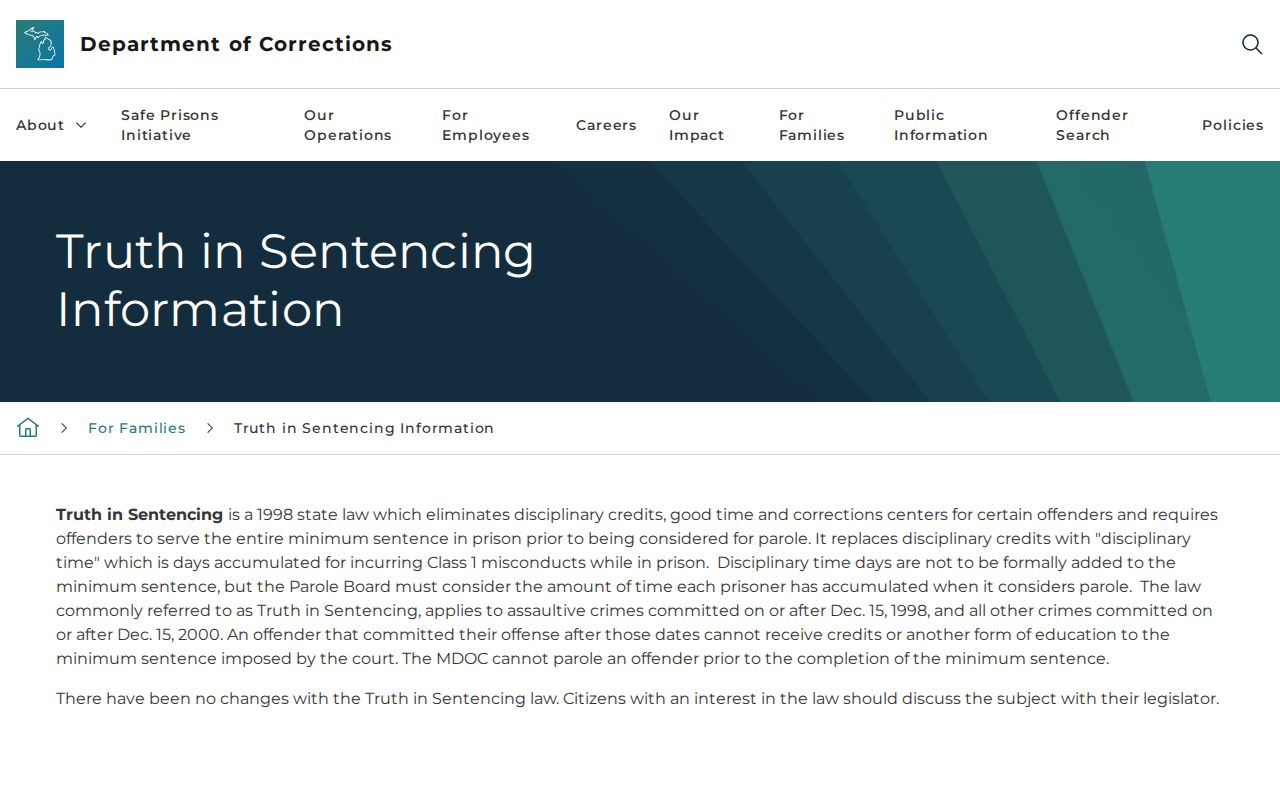
The state explanation applies to MDOC prison terms, while MCL 51.282 governs the distinct Hillsdale county-jail good-time question.
Why Hillsdale Release Dates Change
A date can move because the facts or legal basis change. Some changes alter the sentence calculation. Others do not change the sentence but change the point when physical release or transfer occurs.
| Factor | Possible effect | Record to check |
|---|---|---|
| Jail good-time decision | May affect a county sentence completion date | HCSO sentence calculation |
| Discipline or historical credits | May alter credits when the governing regime allows | MDOC sentence record |
| Court amendment | Can change the controlling sentence or jail credit | Signed amended order |
| Parole grant, denial, or deferral | Changes the path after eligibility, not the original minimum | Board action and OTIS |
| Detainer or other warrant | Can produce transfer instead of community release | Jail release disposition |
| Placement or new information | Can delay a planned parole departure | Parole Release Unit and OTIS |
A favorable parole decision is not the same as departure. The Parole Release Unit records the date, term, conditions, placement, and notices. New information or conduct before release may suspend the action. Use Date Paroled to confirm the completed prison departure.
Confirm Hillsdale Inmate Release
Use MI-VINE for a pending county-jail or MDOC release alert, then confirm through the agency responsible for custody. The VINELink Release Check explains phone, text, email, and PIN registration. A VINE event remains an agency-reported status change, not a certified discharge certificate.
For Hillsdale County Jail, compare the court order with the completed jail release transaction. Request release date and time, disposition, booking number, and any nonexempt transfer destination through the county’s JustFOIA portal if the public roster no longer shows the person. Michigan FOIA allows requests for existing records but does not require the county to create a new calculation or explain why a date changed.
For MDOC, compare status with Date Paroled and the supervision location. Earliest Release Date alone proves only eligibility timing. Maximum Discharge Date is the calculated endpoint, while “discharged” states that MDOC jurisdiction ended. OTIS public data generally remains available for three years after discharge, so preserve the official record needed for later confirmation.
Federal and immigration custody require separate checks. A BOP result marked Released documents the end of the displayed federal confinement, but not every later obligation. The ICE locator addresses possible current immigration detention and does not issue a historical local release certificate. Neither system should be used merely because a Hillsdale case involved a transfer. Start with the county release disposition and follow the named receiving agency.
Hillsdale Court Release Timing
County release timing often turns on a court event rather than a sentence calculator. A bond order authorizes release subject to the case and conditions, but physical departure occurs only after the bond is accepted and the jail checks other holds. A dismissal ends the identified charge or case, yet another case, warrant, or agency request can still control custody. Time served concerns satisfaction of the jail term credited by the court.
Use the correct Hillsdale court. The 2B District Court handles misdemeanors and the initial stages of felony matters. It is at the Courthouse Annex, 49 N. Howell Street, Hillsdale, and can be reached at 517-437-7329. The 1st Judicial Circuit Court handles felony cases after bindover and felony sentencing. It is in Room 6 at 29 N. Howell Street and can be reached at 517-437-4321. Both list weekday public hours from 8:30 a.m. to 5:00 p.m.
Ask for the signed order or a certified register when the date matters. A docket line may appear before jail processing finishes, and the court does not control the jail-management update. Record the order time and the actual release time separately. This is especially important when a same-day event crosses business hours or another agency must act.
Michigan FOIA does not govern court records in the same way it governs county executive records. Hillsdale’s public summary excludes the courts and the County Clerk when acting as Circuit Court clerk. Request judicial records directly from the proper clerk under court access rules. Use JustFOIA for the HCSO release transaction, not for a court order.
If the judgment commits the person to MDOC, departure from Hillsdale County Jail is a transfer into state custody rather than community release. OTIS may not update at the same moment as transport. Preserve the judgment, jail transfer record, and receiving MDOC information. Those documents show the sequence without converting one agency’s release field into a claim that custody ended.
No researched source supplies a single Hillsdale release hour, family waiting area, or weekend departure rule. Do not fill that gap with another county’s practice. The jail can confirm current processing, while the signed order and release transaction preserve what was authorized and what occurred.