
Hillsdale Parole and Probation
Parole and probation can both place a person under Michigan Department of Corrections field supervision, but they begin in different ways. Parole follows an MDOC prison sentence. The Michigan Parole Board permits the person to serve part of the sentence in the community while MDOC retains legal jurisdiction. Probation comes from a court order. A probationer may have served time in the Hillsdale County Jail, yet probation is not an early release from state prison.
The distinction matters when reading a release record. A “Date Paroled” in OTIS documents an actual departure from prison to parole. A probation order documents the court sentence and conditions. Neither status means the sentence or supervision has ended. The profile must say “discharged,” or the responsible office must confirm a discharge, before MDOC jurisdiction can be treated as complete.
| Point | Parole | Probation |
|---|---|---|
| How it starts | Release from an MDOC prison after Board action | Sentence imposed by a court |
| Main proof | OTIS status, Date Paroled, and parole order | Probation order, OTIS status, and court register |
| Who supervises | MDOC Field Operations Administration | MDOC field staff when state-supervised |
| How it ends | Parole discharge or maximum discharge | Court or agency discharge from probation |
- Parole
- Community supervision that follows release from an MDOC prison term.
- Probation
- A court-ordered community sentence, sometimes paired with county jail time.
- Discharge
- The recorded end of supervision or corrections jurisdiction.
- Absconder
- A person whom MDOC reports as unavailable to supervision, not proof of a new conviction.
Check Hillsdale Post-Release Supervision
The official starting point is MDOC Offender Tracking Information System, known as OTIS. Search by the six-digit MDOC number when available because it is more precise than a name. A name search can be narrowed by status, county, age, sex, race, or other displayed filters. Use more than one identity field before relying on a result.
- Open OTIS and select the offender search.
- Enter the MDOC number, or search the full name and possible alternate spellings.
- Open the matching record and compare identifying details.
- Read the exact status: parolee, probationer, discharged, prisoner, or absconder.
- Check the supervision location rather than assuming Hillsdale from the conviction county.
- Use the Region 9 directory to identify the office serving that location.
- Ask the listed office for public status verification or correction when the profile conflicts with a court order.
OTIS is broader than the Hillsdale JailTracker. JailTracker covers people currently held at the county jail. A released jail detainee may leave that roster and still appear in OTIS only if MDOC has a qualifying record. For a person whose case involved county custody but no MDOC supervision, use the sentencing court and county release record instead. The Hillsdale County released-inmate search separates those custody paths.
Hillsdale Supervision Office Details
Hillsdale has one combined MDOC parole and probation office in the county courthouse basement. It is part of Region 9. The office is the right local contact only when OTIS lists a Hillsdale placement or the case record directs the person there. The county of conviction may differ from the place where the person now reports.
Courthouse Basement
29 N. Howell Street
Hillsdale, MI 49242
517-437-3551
The public MDOC Region 9 directory is the source for the office listing. Staff may verify public status or route a correction, but supervision schedules, residential details, protected case information, and full conditions may not be public. State the MDOC number and the specific public field that needs confirmation.
The official Region 9 screen shows the local office within the statewide field structure.
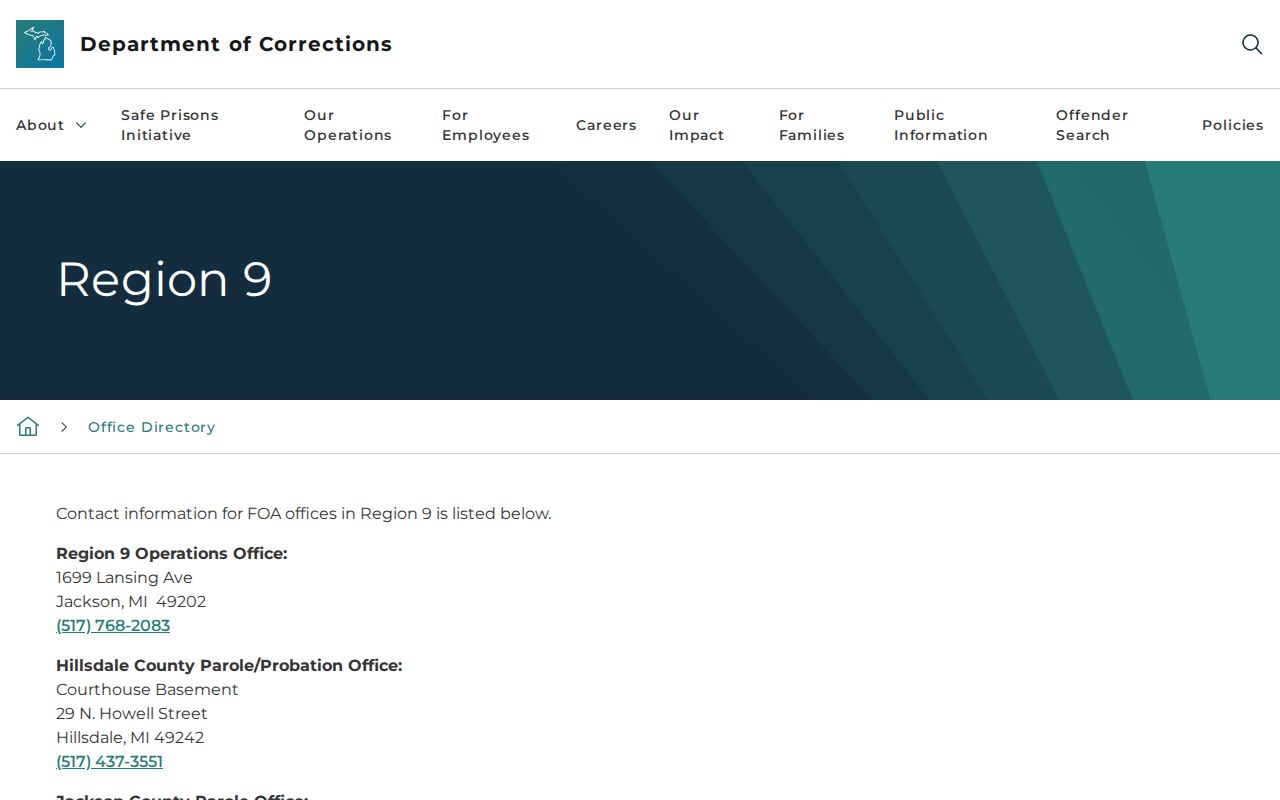
That directory should be checked again if OTIS names a different supervision location.
Hillsdale Supervision Conditions
Conditions are rules imposed by the court, Parole Board, or supervising agency. They can address reporting, travel, treatment, contact, or conduct. Public OTIS data does not necessarily show the full set. A missed report or alleged violation can lead to investigation, a warrant, or formal action, but an allegation is not the same as a final finding.
A parole grant also does not prove that prison release has occurred. Michigan’s Parole Release Unit records the parole date, term, conditions, notices, and placement work after a favorable Board decision. New information or conduct before departure can delay or suspend the release. “Date Paroled” is the stronger historical field for an event that actually happened.
For a probation case, the signed order and later discharge order provide the durable court record. District and circuit court files can differ by case level. A docket entry helps locate the event, while the signed order gives better proof of the result.
Hillsdale Parole Board Records
The Michigan Parole Board is the sole paroling authority for felony prisoners under MDOC jurisdiction. Most decisions use three-member panels. Review begins before the eligibility or reconsideration date, but eligibility does not compel a grant. The Board applies Michigan law, sentence information, institutional conduct, available reports, and the parole standard to the individual record.
A public result needs careful wording. “Granted” means favorable action subject to release processing, placement, continued conduct, and conditions. “Denied” or “continuance” means no release at that review, with another review as ordered. “Deferred” means action was postponed for more information, programming, placement, or another step. A favorable action may later be suspended or rescinded when new information or conduct intervenes.
Michigan posts selected public parole, lifer, and clemency hearings through its public-hearing registration page. Notices generally appear about two weeks to 30 days before the scheduled date, and registration closes two business days before a listed hearing. The rules prohibit recordings, photographs, and screenshots of the proceeding. These hearings are not a complete calendar of every routine parole interview.
Quarterly Parole Board Decisions Reports show aggregate reviewed, granted, denied, and deferred counts and reasons. They are not a public name-by-name decision locator. Use OTIS for person-specific status after posting, then obtain the parole order or MDOC record when formal proof is needed.
Hillsdale Absconder Status Checks
Michigan provides a specific public path for absconder information. When OTIS says “absconder,” MDOC is reporting that the person failed to remain available to supervision. The label is a supervision status. It does not establish a new charge or conviction, and it should not be rewritten as one.
Corrections information belongs with the supervising office. Location tips belong with law enforcement. MDOC publishes an Absconder/Escapee Tip Line at 517-755-0855 and also releases quarterly parole-absconder reports through its legislative reports archive. The freshest public person-specific check remains OTIS, followed by the office listed on the profile.
If a court order and OTIS disagree, keep both records separate while the error is reviewed. Do not infer that a stale status has been corrected merely because a person is no longer visible in a different system.
Correct Hillsdale Supervision Records
Michigan assigns correction requests by the source of the error. A sentencing-court error goes first to the sentencing court. A supervision or absconder error goes to the parole or probation office responsible for the person. MDOC updates OTIS when directed by a court order or supervising agent. Its general accuracy contact is correctionsinfo@michigan.gov.
This division prevents a common dead end. The Hillsdale office cannot rewrite a sentencing judgment, and a court clerk does not control the agent’s current supervision entry. Identify the disputed field, keep a copy of the source record, and route it to the office that created or controls that data.
Hillsdale Supervision Discharge Records
Supervision ends through an official discharge, not through disappearance from a roster. For parole, OTIS may show a maximum discharge date or a discharged status after MDOC jurisdiction ends. For probation, the court register and signed discharge order can establish completion. A person can leave prison on parole while the sentence remains active, so “released” and “discharged” are not interchangeable.
OTIS generally keeps public information for three years after discharge. Later absence may reflect that retention rule or a verified set-aside rather than proof that no record ever existed. A certified discharge certificate or court order is more durable when long-term confirmation matters. Request a specifically described nonexempt record from MDOC or the sentencing court instead of assuming a current web result is permanent.
A Hillsdale release transaction and a supervision discharge answer separate questions. The county record establishes how the jail booking ended. An MDOC record establishes whether state parole or probation jurisdiction continued and when it ended. Keep both when a county jail release began community supervision. If the person transferred to prison, follow the MDOC record instead of describing the transfer as freedom from custody.
When only a web result is needed, save the observation date and exact status. When formal proof is needed, request the underlying order or certificate. That distinction keeps a current public profile from being treated as a permanent legal record.
Michigan FOIA can reach specifically described, existing nonexempt MDOC records. A public OTIS printout may be enough for a current status check. For stronger proof, identify the person and MDOC number and request the particular parole order, discharge certificate, or date record. The agency’s PENPACK is not a general public shortcut; MDOC reserves that certified packet for recognized criminal-justice authorities conducting official business.