
Hillsdale VINELink Release Coverage
Michigan calls the program MI-VINE, short for Victim Information and Notification Everyday. The service is free, confidential, and available around the clock by web and telephone. It reports supported custody and court-status changes. The Hillsdale County Sheriff’s Office services page links MI-VINE, confirming that the state service is the correct notification route for Hillsdale County Jail cases.
County-jail coverage includes release, transfer, and escape events. MDOC coverage includes general release notification for state prisoners. Those are not the same event. A Hillsdale County Jail transfer to another agency ends one local custody stage but may begin another. A state-prison alert concerns MDOC custody. Read the source agency before interpreting the status.
| Custody path | MI-VINE role | Best confirmation |
|---|---|---|
| Hillsdale County Jail | Release, transfer, escape, and supported changes | HCSO, court order, or county release transaction |
| MDOC prison | General release notification | OTIS status and MDOC record |
| Federal or ICE custody | Not the locator for those systems | BOP locator or ICE detainee locator |
Search Hillsdale VINELink Records
Start at VINELink and select Michigan. Search one person by name or identifier. Similar names are common, and a photo may be missing or old. Match at least two details, including the custodial agency, before opening notification registration.
- Select Michigan from the state menu.
- Open the custody or offender search.
- Enter the person’s name or identifier.
- Compare agency and identity fields on each result.
- Open the correct record and read the status as written.
- Note the update time when one appears.
- Confirm through HCSO, the court, or OTIS as the custody path requires.
A missing result does not prove release. Spelling, recent intake, data timing, transfer, or system coverage can affect the search. If the person was recently visible in Hillsdale JailTracker, keep the booking or case number and call the jail. For a state prisoner, search OTIS by the six-digit MDOC number. The Hillsdale County release search gives the full fallback chain.
The official VINELink interface presents the state choice, person search, and notification controls.
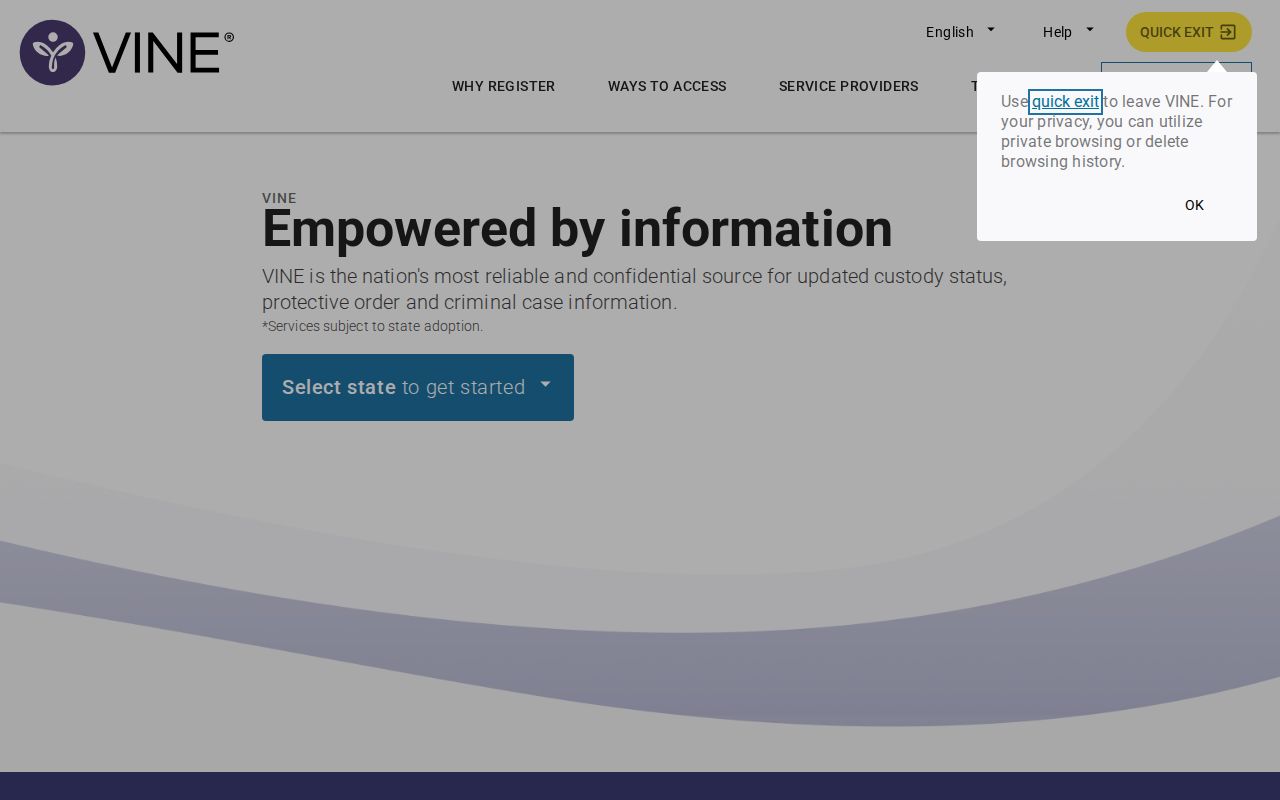
Use the screen for a matched person, while treating the responsible agency as the final source for the event.
Hillsdale VINELink Release Fields
A released result normally means the reporting agency changed its record from custody to a released status. The interface may show agency and event details supplied by that source. It does not serve as a certified discharge certificate. It also does not prove that every warrant, hold, sentence, or supervision obligation ended.
| Field | What it supports |
|---|---|
| Name or identifier | Helps match the person to the custody record |
| Reporting agency | Shows which jail or corrections system supplied the event |
| Custody status | States the source agency’s current reported status |
| Event type | May distinguish release, transfer, escape, or another change |
| Update information | Shows when the service last received or displayed data, if supplied |
The agency field is crucial. “Released” from Hillsdale custody may mean community release, but the county release record can instead show a transfer to MDOC, another sheriff, USMS, or ICE. A transfer is not release into the community. Request the release disposition and nonexempt receiving-agency field when the route is unclear.
Compare event time and observation time when both are available. A court can authorize release while HCSO is still checking another hold. The jail can complete a transfer before the receiving system appears online. MI-VINE can deliver a message after the responsible agency has updated its own record. These timing gaps do not automatically create a conflict.
For a county case, the durable proof is the HCSO release transaction and related court order. The record may identify the booking number, release date and time, disposition, releasing agency, and a nonexempt transfer destination. For state custody, OTIS and an MDOC discharge or parole record provide the longer path. MI-VINE should prompt that confirmation rather than replace it.
Set Hillsdale Release Notifications
Registration begins only after the correct record is matched. VINELink supports phone, text, email, or more than one channel. A phone registration requires a four-digit PIN. Keep it available because the automated call asks for the PIN followed by the pound sign. That confirmation stops repeat calls for the event.
- Open the matched Hillsdale or MDOC record.
- Select notification registration.
- Choose phone, text, email, or several channels.
- Enter the destination and complete any confirmation.
- Create and retain a four-digit PIN for phone calls.
- When called, enter the PIN followed by
#. - For text or email, follow the current prompt; no PIN is required.
MI-VINE calls can arrive at night. Without phone confirmation, calls may continue for up to 72 hours. Do not use a switchboard number that cannot enter the PIN. Multiple phone numbers and email addresses can be registered. Forgotten-PIN help is available at 800-770-7657 by choosing a representative.
Hillsdale Victim Notice Layers
HCSO’s MI-VINE link supplies the local connection to the statewide system. Michigan also maintains a separate notice layer through MDOC Crime Victims Services. Direct victims seeking added events such as parole-hearing and decision notices can contact that unit at 877-886-5401. Ordinary VINE custody alerts and Crime Victims Services registration are not duplicates.
The ordinary MI-VINE record is useful for a specific release or transfer alert. Victim-services registration addresses added MDOC proceedings and notices. Public Parole Board schedules and quarterly decision reports serve still different purposes. None replaces a completed jail release transaction, parole order, or discharge certificate when a durable record is needed.
Telephone access also matters when the web interface is unavailable. MI-VINE’s main line is 800-770-7657, and TTY access is available at 866-847-1298. The VINEmobile app offers mobile access to the same service. These channels belong to MI-VINE; they should not be confused with the Hillsdale County Sheriff’s Office app, whose published feature list does not promise inmate search or release alerts.
Registration should stay tied to the correct agency record. A new booking or move can create a different record path. Recheck the identifier and agency if an expected alert never arrives. Michigan’s materials expressly caution that VINE is not the only source, so missed notice must not be treated as proof that no event occurred.
Confirm Hillsdale VINELink Releases
Michigan warns against relying on MI-VINE alone. Data can lag, a transfer can be mistaken for a community release, and the service does not operate as the federal or immigration locator. Use the reporting agency as the next step.
For Hillsdale County Jail, call 517-437-7317 and use the court order or county release record. For an MDOC prisoner, compare OTIS status, Date Paroled, and supervision location. A former federal prisoner must be checked through the Bureau of Prisons locator and federal court record. Possible ICE detention requires the ICE Online Detainee Locator and case-specific follow-up.
Preserve the name, identifier, agency, event type, event time, and time the notice was received. If sources conflict, favor the signed current court order and the responsible custody agency’s completed transaction. Timing can differ because a court may authorize release before jail processing finishes, while a VINE alert may arrive after the source update.
Hillsdale Release Alert Fallbacks
When MI-VINE has no match or no expected alert, return to the source that owns the custody record. Hillsdale JailTracker is useful before release because HCSO describes it as information for people currently held. Once the name disappears, the roster does not state whether the person posted bond, completed time, transferred, or left under another court order. Call Hillsdale County Jail at 517-437-7317 with the booking or case number.
The court record can explain the authority for a release. Hillsdale’s 2B District Court handles misdemeanors and early felony proceedings. The 1st Judicial Circuit Court handles felony cases after bindover and felony sentencing. Useful records include a bond order, dismissal, judgment of sentence, amended order, probation order, or register of actions. MiFILE and TrueFiling are filing tools and do not provide public court-record access for the district court.
For a durable county record, submit a focused request through Hillsdale County JustFOIA. Ask for the nonexempt booking and release record for the named person and booking. Useful fields include admission date, release date and time, release disposition, booking number, court number, and any nonexempt receiving-agency field. Michigan FOIA reaches existing records. It does not require the county to create a new explanation or report.
State-prison questions move to MDOC OTIS. Search by the MDOC number where possible, then read the status and location before sentence dates. Date Paroled supports an actual departure to parole. Earliest Release Date is an eligibility milestone, and Maximum Discharge Date is the calculated endpoint. An MI-VINE state-prison notice should be checked against those exact fields.
Federal and immigration paths are outside MI-VINE’s stated role. The BOP locator covers federal prisoners from 1982 forward and can show a Released status with a date. ICE’s locator addresses people who may currently be in immigration detention. A no-result in either system has limits, so use the relevant federal court, BOP, ICE, or local transfer record for confirmation.
Keep the search narrow and event-focused. Record the identifier, agency, source status, and date observed. If a transfer is suspected, ask which agency received the person. This prevents a Hillsdale custody change from being mistaken for release into the community and creates a clear path to the record that can verify the next stage.
MI-VINE may also report supported court-status changes, but a notice is not the signed judicial record. Ask the proper Hillsdale clerk for the order or register when the legal basis for release matters. Then compare that document with HCSO’s completed release transaction. One shows authority; the other shows the custody event.